By the Seovoro Team · Last updated October 2, 2026
Key takeaways
- Google says optimizing for its generative AI features is still SEO. There is no special markup or secret trick required.
- To be shown, a page must be indexed and eligible to appear with a snippet, and your site must be included in generative AI features in Search Console.
- Unique, helpful, expert-led content matters more than anything else in Google's guide.
- Measure with Search Console's Generative AI performance report. No one can guarantee citations or fast rankings.
More searches now end with an AI-written answer at the top of the page. Google shows AI Overviews on many queries and offers AI Mode for longer, conversational questions, while tools like ChatGPT and Perplexity answer questions directly. For a business, the new goal is not only to rank, but to be one of the sources those answers name. This guide is based on Google's own official guidance and explains what actually helps, step by step, with no hype and no guarantees.
In this guide
- What are AI Overviews and AI Mode?
- A reality check before you start
- 10 steps to get cited in AI answers
- Myths Google says you can ignore
- Example: rewriting an opening
- Quick checklist you can copy
- How to measure AI visibility
- Your 30-minute action plan
- Common mistakes to avoid
- Frequently asked questions
- Sources
What are AI Overviews and AI Mode?
AI Overviews are short AI-generated summaries that appear above the usual results for some searches, with links to the sources used. AI Mode is a separate, more conversational Google search experience. It is built for complex, multi-part questions. Google explains that both rely on its core Search systems: they retrieve relevant pages from the Search index, and they can run several related searches at once (called query fan-out) to cover different parts of a question before writing an answer. Both show clickable links to the pages that support the answer, which is where your chance to be cited comes in.
| AI Overviews | AI Mode | ChatGPT and Perplexity | |
|---|---|---|---|
| Where it appears | At the top of some Google results | A separate Google search experience | Their own apps and websites |
| Best for | Quick summaries | Complex, multi-part questions | Conversational research |
| How sources show | Links alongside the summary | Links within the answer | Citations or links (varies by tool and settings) |
| How to measure | Search Console, Generative AI report | Search Console, Generative AI report | Analytics referrals and prompt testing |
Share of searches that show an AI answer varies by industry and by study, so treat any single percentage with care. What matters is that the format is now common enough that ignoring it means leaving visibility on the table.
A reality check before you start
- No one can guarantee a citation or a fast ranking. Google says even a page that meets every requirement may not be crawled, indexed or shown. Indexing and serving are never guaranteed.
- There is no secret markup. Google says optimizing for generative AI search is optimizing for the search experience, and so it is still SEO. Read it yourself: Optimizing your website for generative AI features on Google Search and AI features and your website.
- Be careful with third-party advice, including ours. Google suggests checking any AEO or GEO advice against its official guidance (evaluating third-party SEO advice). We have built this article from that guidance, so you can check every point.
- Different tools behave differently. Content cited in Google may not be cited in ChatGPT or Perplexity, so measure each one separately.
10 steps to get cited in AI answers
1. Make sure Google can find, index and show your page
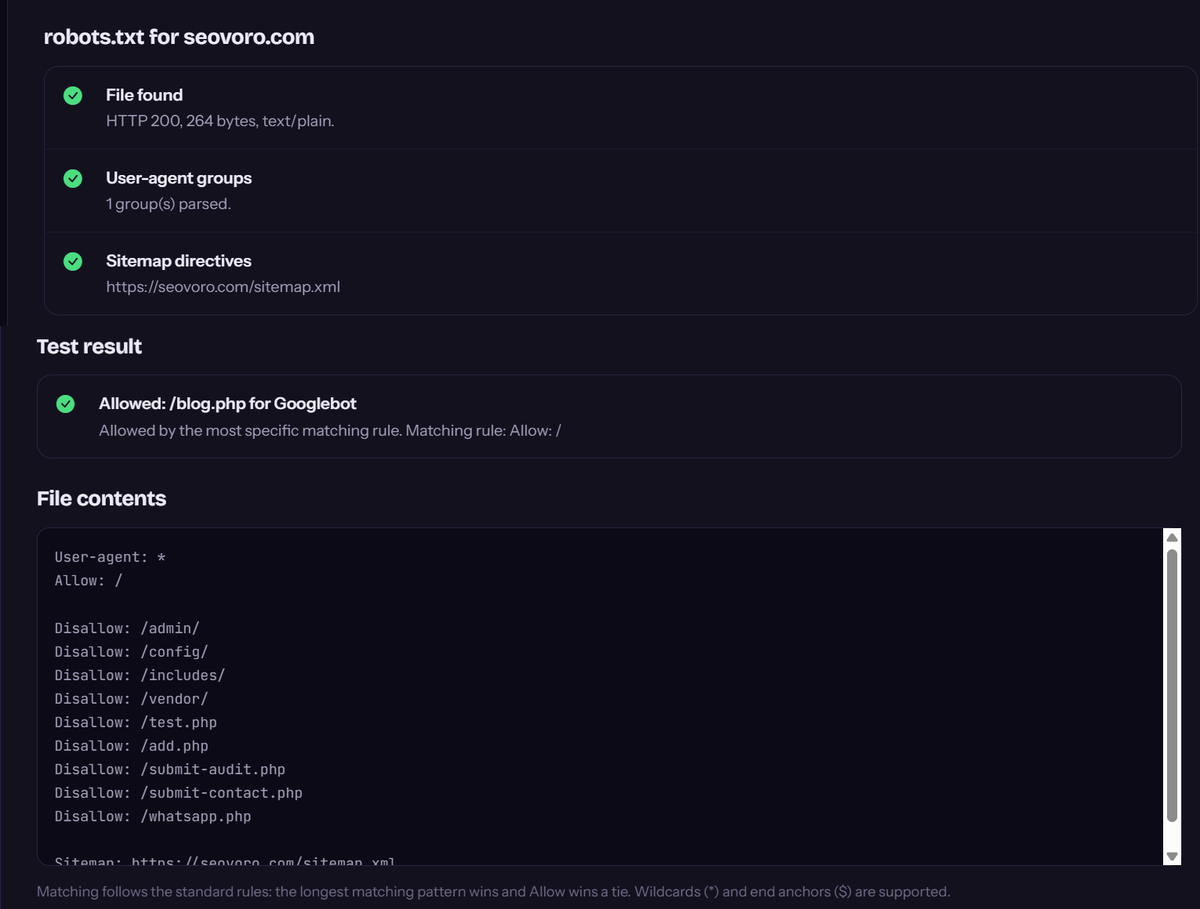
To appear in generative AI features, a page must be indexed and eligible to show with a snippet. Google also says a site must be included in generative AI features in Search Console to be eligible, so check the Search Console help page. Then make it easy for Google to find the page: add it to your XML sitemap, link to it from related pages and from your blog list, and use the URL Inspection tool in Search Console to request indexing for important new pages. Check that you are not blocking Googlebot in robots.txt (use our Robots.txt Tester), that the page has no noindex tag, and that you are not using nosnippet on pages you want quoted.
2. Create unique, non-commodity content
Google says this will likely influence your presence in AI search more than any other tip. Commodity content is common knowledge that anyone could write, such as a generic "tips" list. Non-commodity content has a point of view, first-hand experience or expert insight that goes beyond the obvious. Ask yourself what you know from real work that a summary of other websites could never tell the reader.
3. Put the answer first
People and AI systems both like clear, direct answers. Start each section with a direct answer in one to three sentences, then add detail. If your page is about "how long does SEO take", say it in the first lines instead of burying it after a long introduction.
4. Write for readers, with a clear structure
Use headings, short paragraphs, lists and simple tables so the page is easy to follow. Headings that match real questions (from "People also ask", customer emails and sales calls) help readers. Google says you do not need to write in a special way for AI, cut your content into tiny pieces, or chase every keyword variation. Its systems understand synonyms and meaning. Write for your audience and the structure follows.
5. Show who wrote it and why you can be trusted
Show the author, a short bio and a real "last updated" date. Explain your experience, cite reliable sources, and be honest about limits. Content that is helpful, reliable and people-first is the standard Google describes in its guide to helpful content.
6. Support your text with high-quality images and video
Google says its AI features can bring in relevant images and video, which means more ways for your site to show up. Add original screenshots, diagrams or short videos where they genuinely help, with descriptive file names and alt text.
7. Keep structured data accurate, but do not obsess
Schema markup (Organization, Article, FAQPage, Product and others) helps machines understand a page and can make you eligible for rich results. It is not required for AI features, and there is no special markup to add. Only mark up what is visible on the page, and keep it accurate.
8. Build a real brand, not fake mentions
Customers and AI systems learn about businesses from many places. Keep your LinkedIn, Google Business Profile and other profiles consistent and complete, earn genuine reviews and take part in communities where your customers ask questions. Google says seeking inauthentic mentions is not as helpful as it seems, so earn mentions by being useful.
9. Keep the technical basics strong
Fast, mobile-friendly pages, a good page experience and little duplicate content all help. Check your speed with the Site Speed Tester, fix broken links with the Broken Link Checker and keep your XML sitemap clean. You do not need perfect code, but readable, semantic HTML helps people and assistive tools.
10. Keep business details and content fresh
If you run a local business or a store, Google says tools such as Google Business Profile and Merchant Center can help your details appear in AI responses. Learn how to add and manage your business details on Google. Review important pages every few months, and update facts, dates, prices and examples when they change.
Myths Google says you can ignore
A lot of advice online treats AI search as a separate game with its own tricks. Google's guide pushes back on several of them for its own generative AI features:
- "You need an llms.txt file or special AI markup." Google says Search does not use these files. It says creating them will neither help nor harm your Google visibility, but you can still create them for other tools that read them.
- "You must chop content into small chunks." Not required. Google's systems can understand pages that cover several topics, and there is no ideal page length.
- "You must rewrite pages specially for AI." Not needed. You do not have to capture every long-tail variation of a query.
- "You need lots of mentions across the web." Seeking inauthentic mentions is less helpful than it looks. Core ranking systems focus on high-quality content, and spam systems work against manipulation.
- "You must add special schema." There is no special schema.org markup for AI features. Keep using structured data for rich results, but do not overfocus on it.
- "A tool knows Google's secret AI metrics." Google says no third-party tool has access to its internal ranking or AI systems. Use tools if they help you, and check their advice against Google's official guidance.
This does not make AI search unimportant. It means the best investment is the same as before: helpful, original content on a technically sound site that people trust.
Example: rewriting an opening
Here is an illustration of the "answer first" idea. The example is invented to show the technique.
| Before | After |
|---|---|
| "Local SEO is a very important part of modern marketing and has many benefits for businesses of all sizes. In this article we will look at what it is and why it matters." | "Local SEO is the work of improving your Google Business Profile, website and reviews so your business appears when people search nearby. Many small businesses see early changes within weeks and steadier results over three to six months." |
The second version answers the question straight away, names the subject and gives a useful timeframe. A reader gets what they need in two sentences, and so does any system summarizing the page.
Quick checklist you can copy
- Page is indexed and not blocked or set to noindex or nosnippet
- Site is included in generative AI features in Search Console
- Page is in the sitemap and linked from related pages
- Unique content with first-hand experience or expert insight
- Direct answer in the first lines of each section
- Clear headings, short paragraphs, lists and tables where they help
- Author name, short bio and last updated date visible
- Original images or video that support the text
- Schema accurate and matching visible content
- Brand details consistent on all profiles
- Page loads fast on mobile
- Facts and dates reviewed in the last few months
How to measure AI visibility
You cannot track AI citations perfectly yet, but you can get a useful picture:
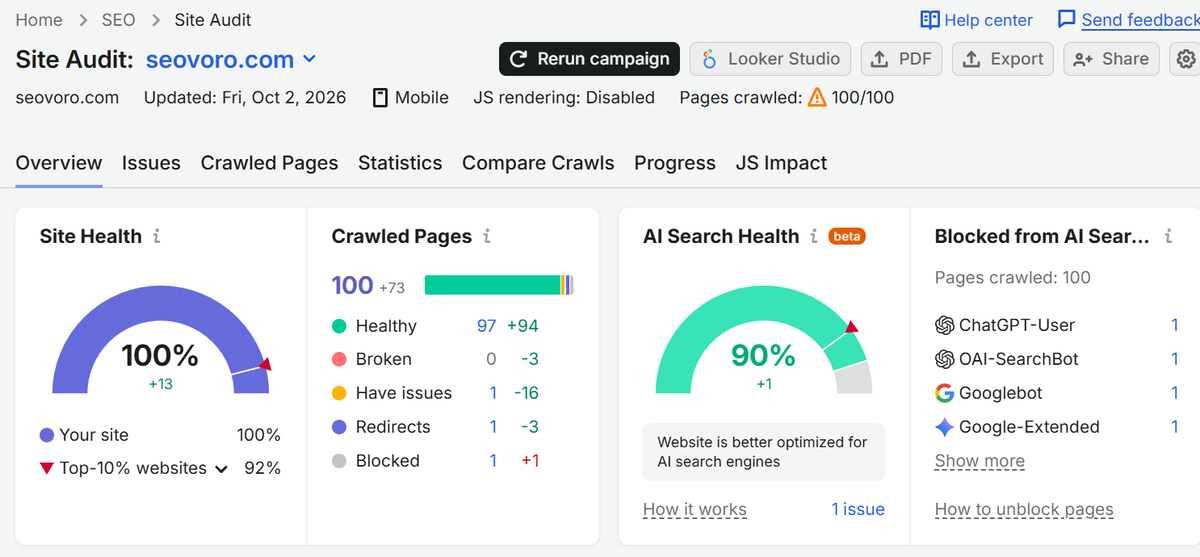
- Search Console. Use the Generative AI performance report to see how your content performs in Google's generative AI features. Clicks and impressions from these features are also part of your overall search traffic. In September 2026 Google added a multimodal search filter to its performance reports, which shows searches that start from images (see the Google Search Central announcement).
- Prompt testing. Pick 10 to 15 questions your customers ask and run them in Google, ChatGPT, Perplexity and Gemini each month. Record whether your brand or pages are mentioned. Our free AI SEO prompts include a set of test prompts.
- Referral traffic. In your analytics, check visits that come from AI tools, which usually show as referrals.
Use a simple table to track your tests each month:
| Prompt | Tool | Brand mentioned? | Page cited | Date |
|---|---|---|---|---|
| Best SEO tools for checking robots.txt | ChatGPT | Yes or no | URL or none | Month and year |
| How do I get cited in AI Overviews? | Yes or no | URL or none | Month and year |
Your 30-minute action plan
- Pick one important page on your site.
- Check in Search Console that it is indexed, and that your site is included in generative AI features.
- Rewrite the first two sentences so they answer the main question directly.
- Add one original example, number or screenshot from your own work.
- Add the author name and a "last updated" date.
- Link to the page from two related pages on your site, and make sure it is in your sitemap.
- Request indexing in Search Console if the page is new or changed.
Optional: prepare for AI agents
Google also notes that AI agents, such as browser agents that book or compare things for people, may visit sites in the future. If this matters to your business, make your pages easy to use: clear structure, readable HTML and accessible forms. See Google's pointer to agent-friendly website practices.
Common mistakes to avoid
- Scaled content. Publishing many pages for every variation of a query mainly to manipulate results violates Google's scaled content abuse spam policy. More pages do not make a site higher quality.
- Publishing unreviewed AI content. If you use AI tools to help write, the result must still meet Google's standards. Read its guidance on AI-generated content. Always edit and fact-check.
- Chasing tricks. Hidden text, fake FAQs and fake mentions can harm trust and may break Google's rules. Google released a spam update on September 24, 2026, and you can follow ranking updates on its Search Status Dashboard.
- Blocking the wrong crawlers. If you want to be cited by an AI tool, do not block the crawler that powers its search results.
- Ignoring your brand. Strong content on a site nobody recognizes has a harder time being cited.
- Expecting instant results. Re-crawling and trust take weeks to months.
Frequently asked questions
What is the difference between AI Overviews and AI Mode?
AI Overviews are short summaries shown on the main results page. AI Mode is a separate, more conversational experience for complex questions. Optimize for both, and use Search Console to see how your content performs.
Do I need special schema to appear in AI Overviews?
No. Structured data is not required for generative AI search and there is no special markup to add. It is still worth using for rich results.
Do I need an llms.txt file?
Google says Search does not use it, and that creating one neither helps nor harms your Google visibility. Some other tools may read such files, so it is optional.
How can I get a new article indexed faster?
There is no guaranteed way. You can help by adding the page to your sitemap, linking to it from related pages, making sure it is not blocked, and requesting indexing with the URL Inspection tool in Search Console. Google may still take time to crawl and index it.
Is traditional SEO still worth doing?
Yes. Google says its AI features are rooted in its core ranking and quality systems. See the difference between generative engine optimization and answer engine optimization.
Should I block AI crawlers in robots.txt?
It depends on your goals. Blocking can keep content out of some AI tools but may also reduce your chances of being cited. Decide on purpose, and test your rules with our Robots.txt Tester.
Will AI answers reduce my traffic?
For simple questions, some people may get what they need without clicking. Pages that offer depth, original value and a reason to visit are more likely to earn clicks. Watch your own numbers in Search Console rather than relying on general claims.
How long does it take to get cited?
It varies. Updated pages can be picked up within weeks, but building the trust that leads to regular citations usually takes months, and there are no guarantees.
Can a small business get cited by AI?
Yes. Specific, locally relevant answers with real expertise can beat big sites on narrow questions. Start with the questions your customers actually ask.
Sources
- Google Search Central: Optimizing your website for generative AI features on Google Search
- Google Search Central: AI features and your website
- Google Search Central: Creating helpful, reliable, people-first content
- Google Search Central: Guidance on using generative AI content
- Google Search Central: Spam policies (scaled content abuse)
- Google Search Central: Guidance on third-party SEO tools and advice
- Google Search Central: Announcing web multimodal Search performance reporting in Search Console
- Google Search Central: Search Console help: Generative AI performance report
- Google Search Central: Search Status Dashboard: ranking updates
Next steps
Start with one important page and follow the 30-minute plan above. If you would like expert help, explore our AI SEO and GEO service, our AEO service or request a technical SEO audit. You can also run our free site audit on any page right now.
Written by Seovoro SEO Team
SEO, AEO & AI Search specialists at Seovoro. View author profile